
#13 Enlightenment

There are certain activities that we would never think of undertaking in a language familiar to us: among these is reading the major titles of the domestic daily press. The material (content and format) is, however, quintessentially relevant for learning languages like a machine.
A miscellaneous news story in the « HS Visio » section of Helsingin Sanomat on May 16, 2026 catches our attention. Tekoälyä turbovaihteella, AI in turbo gear. It apparently tells the story of the misadventures of an entrepreneur in smart agents. (Storås, 2026)
It should be noted that we read, as much as possible, the print edition of newspapers. That’s a detail essential to the practice we shall depict in the following. And as time goes by, and we strive in this collection of texts to clarify our own pedagogical intuitions, it seems increasingly clear to us that that practice (a variation on the eternal matching exercise) is more than just ancillary to the hopes of progress: it constitutes, in fact, the cornerstone thereof.
As is often the case in the columns of Helsingin Sanomat, the opening tone is epic, laying the scene. Our entrepreneur had set his alarm clock so he could take a nap. The alarm went off and...
[Hän] näki oli vain sumua.
[He] saw only fog.
Lost his sight! The second paragraph comes to relieve our perplexity. Researchers found out that
Monet tekoälyä eniten käyttävät työntekijät ylikuormittuvat.
The principle is extremely simple. We read, from left to right, as long as we understand what’s being said. First parsing.
… Monet… Numerous… tekoälyä… AI… it’s the partitive (direct object) so we let the reading window widen… monet tekoälyä eniten… paljon in the superlative: most… monet tekoälyä eniten käyttävät… using, present participle used as an attributive adjective… in wait for a head-noun… monet tekoälyä eniten käyttävät työntekijät… end of window: työn-tekijät, job-takers, workers… and all in all: many of the workers using AI the most… ylikuormittuvat… verb… yli-, over-… kuorma, burden…
Given the context, ylikuormittuvat cannot mean much apart from become overloaded. Since the hypothesized meaning fits quite nicely, further assumptions gain in probability: the semantic breakdown yli-kuorm- for something related to over-load, the suffix -u(a) for forming intransitive passive (to be in a state of being done something) or inchoative (to come to that state) verbs from their transitive primitive. Perhaps that’s the first time you are exposed to an inchoative form, in wait for a second sample, and a third, to crystallize what confirms itself as a pattern.
Many of the workers who use AI the most become overloaded.
News flash. Explanation: humans are the limiting factor.
Koska tekoälyagentit tekevät monia tehtäviä nopeammin kuin ihminen, saattaa jo pelkästään kärryillä pysyminen olla hankalaa.
… Since / AI agents / do several tasks / faster than the human... second clause… might / keeping the little word jo for later / merely… we blank on kärryillä… pysyminen is persistence… olla hankalaa… be difficult… we backtrack and order things… even merely persistence in [kärry-] might be difficult…
We get the point, it gets tough to follow. Maybe that’s just fine in that very hour and we read on. (Kärryillä is in the cart : staying in the cart.) We don’t appreciate the magnitude of the fatigue experienced by reviewers of AI productions. A software developer joins the debate, who pinpoints the irony in the fact that
… tekoälyn tuottama koodi vaati huolellisempaa tarkistusta kuin ihmisen kirjoittama.
The meaning flows, and our bank of grammatical patterns solidifies as we move along.
… tekoälyn tuottama koodi… first nominal clause, parser stop… of AI / some infinitive (or participle, we remember that Finnish classes participles as infinitive forms) from tuottaa, to produce / code… very likely code produced by AI… now the verb and its direct object: vaati huolellisempaa tarkistusta… requires / a comparative embedding the stem noun huoli, care, concern / a verbal noun in the family of tarkka, accurate that renownedly features also tarkoittaa, to mean… tarkistaa is to check, to inspect… so requires more careful checking… kuin ihmisen kirjoittama… kuin introduces the complement of the comparative… and we have the precise formal counterpart to tekoälyn tuottama, a genitive followed by a kind of infinitive used as a noun attribute… than written by humans…
We’ve outlined here a sample of consciousness at work that thinks in grammatical terms. Perhaps our stream is leaner and rather resembles the following.
… tekoälyn tuottama koodi… AI generated code… vaati… requires… huolellisempaa…kuin… more care… more careful…than… huolellisempaa tarkistusta kuin… more careful review than… ihmisen kirjoittama… written by a human… than code that has been written by a human…
In all instances, grammar inference is likely to operate underneath. Exposure to forms confirms preexisting notions (or starts stacking new ones). Significantly, kirjoittama and tuottama are of the same brew as (Rousseau) innoittama, (that Rousseau has) inspired from a previous read. They are specimens of the agent participle (agenttipartisiippi), a distinct version of the passive past participle that specifies the agent. Indeed, Finnish has a nuanced palette in that grammatical drawer. English past participles (inspired, written or produced) do not specify whether the action has a (human or otherwise somehow generative) agent. (Some instances might semantically imply one, such as written, but connected caves can have been so by the hand of nature.) In Finnish, a passive past participle (betrayed by an ending in -tty, -ttu, -ty,-tu) implicitly means there is one, with yhdistetty carrying the whole of that has been connected by someone (or something endowed with some agency). The form is nevertheless impersonal and the agent left unspecified. Should we wish to express it, we are to use the agent participle, which admits a subject in the genitive or a possessive suffix. Hence, tuottama fits the translation of (that has been) produced by AI where the agent is explicit, but doesn’t match the past participle participating in a compound tense in (wind energy) has been produced (on ollut tuotettu) or used as a mere attribute in produced sensations. The very kind of participle resorted to tells about the focus and intent. For nature can be personified after all:
In the picture are caves (that have been) connected by (the hand of) nature.
A natural Finnish equivalent features the agent participle.
Kuvassa näkyvät naturin yhdistämät luolat.
In contrast, in
Archaeologists have excavated connected caves.
who or what connected the caves is no concern: the fact of the matter is that they are connected. A fluent rendering, it seems, would trend towards
Arkeologit ovat kaivaneet yhteydessä olevia luolia.
Caves being in connection. That’s how they are, no matter how that state was reached.
Do native speakers brew grammatical concepts as they parse? In other words, does the explicit mastery of one’s familiar grammar’s formal principles (grown for example by reading grammar books or having been a good pupil) augment the ability and ease to grasp meaning in native utterances? Well, perhaps more than the apparent naturalness of native language understanding would suggest. Young children are trained on the colossal corpus of environmental spoken and written language, and thereby grasp grammar like a machine, that is, through the mere repeated exposure to patterns that they otherwise do not explicitly tag. (They clearly do, to some extent, since they are able to produce grammatical speech without having been schooled in the corresponding concepts.) With that, the overwhelming majority of everyday contents and contemporary works of the mind are parsed just as spontaneously. But should the genre differ (the epitome of bizarrerie plausibly being patent syntax, but we can also come up with poetry or fridge instructions) or the time have left a patina of archaism, and a knowledgeable parser, very aware of grammatical categories and seasoned in sentence dissections might have an edge. (In our school days, a canonical exercise we practiced with no respite for years was the tagging of syntactical units in a wide range of texts, from clauses down to minimal phrases, with their nature and function. Incidentally, it’s not preposterous to view a connection from that early practice to our obsession with matching in our later linguistic ascesis.) We are just inquiring here. We also need no confirmation from some scientific eagerness for peer-reviewed novelties, for, in what matters, namely the processing of foreign languages, such an edge is beyond doubt for us. Asymptotically, a lifelong, full-time stream of matching like a machine might grant enough exposure to grammar at work for a fully subliminal parser to be able to run with ease through most texts, but our urgency to read interesting things in extenso and without clues prompts us to shorten the delays. The shortcut being to soon dive into a good old grammar book and delight in stints of tagging while matching, testimonies of which abound in this and previous essays.
So, why is humanity getting tired, or even, going blind? With AI taking over simpler tasks, a healthcare advisor weighs in, humans are left with those, more complex, which only they can understand. As the latter’s share is plummeting dangerously, with no sign of the load easing to healthy levels, we are rather leaning toward another expert’s stance: the best part, that which consumes and thrills, is being sucked out, and what remains is a poor surrogate of work, which is to mind the machine. Then comes an epiphany to the Harvard Business Review, which Helsingin Sanomat summarizes as follows.
Tuottavuushyödyt uhkaavat valua hukkaan, jos tekoälyhankkeissa kiinnitetään huomiota tuottavuuden tehostaamiseen eikä psykologiaan.
We have a physical newspaper at hand, as well as a fountain pen. We read, and strike through each sentence fragment as it gets perfectly clear to us. The goal is to have, in the end, everything struck through.
… Tuottavuushyödyt… tuottavuus-hyödyt… gains (near tuottaa anew) of productivity… uhkaavat… threaten… valua hukkaan …
The last expression seems quite idiomatic: we turn on our online translator, an archaic one, one that translates on the fly as we type in. It is preferred to a translator in bulk, for it precisely mimics matching and therewith exposes us to the very activity that we are training to become fluent in. There is for this preference a corollary reason that deserves to be insisted upon: it’s possible in such an interactive translator to query a sentence’s meaning in spots only, which makes the tool complementary to our own internal matching process. As we do just now: we already parsed the beginning of the sentence on our own and start the typing with valua… flow… completed into valua hukkaan… flow away, be wasted. All in all:
… *The productivity gains / threaten / to be wasted …
We either know or intuit that uhkaavat has here an impersonal touch. For the nominative productivity gains don’t threaten anything: *it threatens them to be wasted.
… The productivity gains are at risk of being wasted …
That’s clear: we cross out Tuottavuushyödyt uhkaavat valua hukkaan.
… jos tekoälyhankkeissa kiinnitetään huomiota… *if in AI projects (tekoäly-hankke-i-ssa) / it is paid attention… tuottavuuden tehostaamiseen… teho- for everything powerful and efficient… -minen (illative -miseen) forming action nouns… tehostaamiseen… efficiency enhancing… tuottavuuden… of productivity… productivity boosting… eikä psykologiaan… and not psychology.
… if AI projects focus on boosting productivity rather than psychology.
We triumphantly strike through, before moving on to the next sentence. Here is a sample of the battlefield.
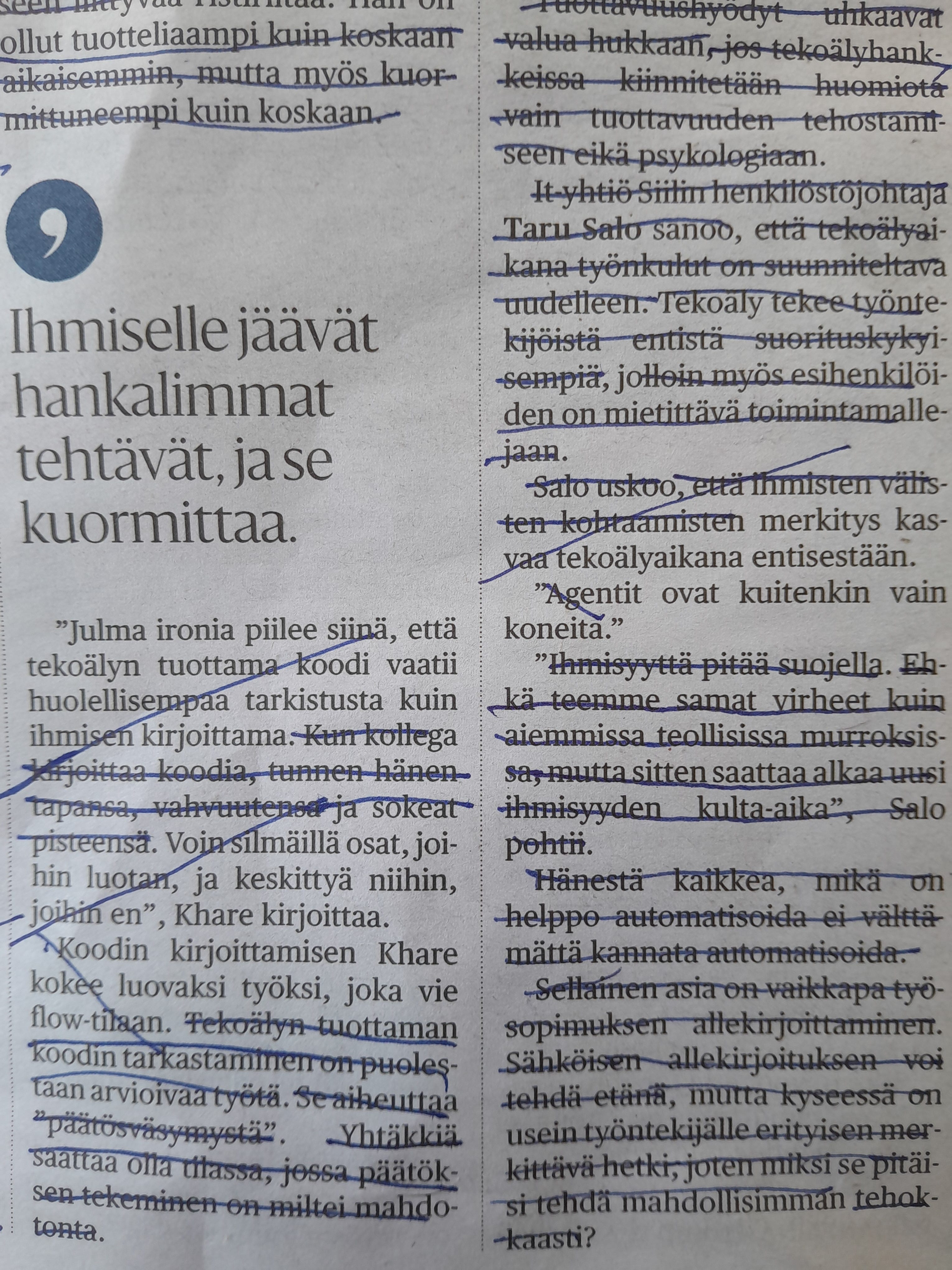
On second reading, doubts arise.
The productivity gains are at risk of being wasted if AI projects focus on boosting productivity rather than psychology.
It seems to us there might be some confusion here, though a predictable one from a human standpoint that we won't assume the Harvard Business Review lacks. It’s hard indeed to see how optimizing for boosting productivity could lead to anything but productivity gains. Gains in the grand total, from the perspective of the machine. Collateral damage to humans in the loop, concomitant with their diminishing returns, is the least of its concerns. At most, the statement holds in the very short term: as long as it still has a need for spotty turnkeys, the machine had better make sure that they don’t go blind at once. Helsingin Sanomat, here and elsewhere, is not too big on commentary. It’s served raw and readers are left to draw their own conclusions.
Back to our entrepreneur, who spontaneously regained his sight after a few hours, and from whom we might expect a moral to the story.
Mitä [hän] ajattelee oppineensa tapauksesta?
“Kyllä aloin miettiä, että minulla on ihan moraalinen velvollisuus, koska tässä on mahdollisuus rakentaa niin paljon hyvää.”
… Mitä hän ajattelee… what does he think… oppineensa… oppia is to learn…suffix possessive -nsa… (him) learning? (him) having learned?.. tapauksesta… elative: from the case… so *what does he think having learned from the case …
And indeed, oppineensa is the past active participle (no such thing really exists in English) in the 3rd person possessive form (that neither): (him) having learned. Maybe we type the word in our translator. At least it informs us of the semantic stem and faintly thinks through the form: learned, having learned. Or for a change we turn to the Wiktionary: oppineensa redirects to oppinut and from there we crawl our way up to oppia, catching a glimpse of conjugation and declension tables in passing. In fact, none of those. We have it almost all crossed out: Mitä [hän] ajattelee oppineensa tapauksesta? and the miss is no full blind spot: something rather verbal, and possessive, about learning. In context, it all naturally strengthens into:
What does [he] think he has learned from the case?
… Kyllä aloin miettiä, että… adverbial kyllä just connotes insistence: I did start to think that… minulla on ihan moraalinen velvollisuus… I have fully? moral ?.. velvollinen… obliged, bound… velvollisuus… obligation… I really have a moral obligation… koska tässä on mahdollisuus… because here there is the possibility… rakentaa… to build… niin paljon hyvää… so much good.
To lose one’s sight as a martyr. Last stroke in the ongoing punch line: our entrepreneur learned from the New York Times what explains present-day low birthrate. Helsingin Sanomat rephrases his account in indirect speech:
Yksi syy on se, että tulevaisuuden ennustaminen on mennyt niin hankalaksi.
One reason is that predicting the future has become so difficult.
and quotes his conclusion:
"Ihmisillä ei ole pitkää tähtäintä olemassa", [hän] selittää.
“People don’t have a long-term perspective,” [he] explains.
Tähtäin is sight, pitkää tähtäintä, long sight. And at the bottom of the column, still in quotation marks:
“Sama sumuisuus, nopeasti muuttuva hyvin epävarma ja arvaamaton tulevaisuus johtaa siihen, että painat täysillä, kun sulla on saumaa. Silloin tekee työtä kuin viimeistä päivää, kun ei tiedä huomisesta mitään”.
… Sama sumuisuus… same ?… nopeasti muuttuva hyvin epävarma ja arvaamaton tulevaisuus… *rapidly changing very uncertain and un-guess-able? future… unpredictable… johtaa siihen, että… *leads to this, that… painat täysillä, kun… you press? in the whole?.. to the maximum… you give everything you have… kun sulla on saumaa… when you have ? …
… a rapidly changing, highly uncertain and unpredictable future …
That kind of future.
… leads to the fact that you give everything you have …
We almost struck it all through. Sama sumuisuus, nopeasti muuttuva hyvin epävarma ja arvaamaton tulevaisuus johtaa siihen, että painat täysillä, kun sulla on saumaa. Let’s try and fill in the blanks. Sama sumuisuus for that same nebulosity, fog, steam, mist? Kun sulla on saumaa for when you have a chance, an opening, an epiphany, a good vision? We can patrol the dictionary, or just be content with the fogginess.
… Silloin tekee työtä… *then you do work… you work… kuin viimeistä päivää… *as in the last day… as if it were your last day… kun ei tiedä huomisesta mitään… *since you don’t know of tomorrow anything… since you know nothing about tomorrow.
Final word, final shot. Kun ei tiedä mitään. A parable of the blind whose lingering irony devolves into hilarious sarcasm? Let’s hope for the cast of the day that the saying that « there is no such thing as bad publicity » still stands.
Beneath its appearance of whimsical frivolity, the practice of striking through newspapers has real merits. As with everything else in language learning like a machine, we didn’t theorize in the lab what we would then have practiced. (We don’t need three-point justifications to act.) The awareness and pedagogical reverse-engineering are a posteriori.
First, there is certainly a sense of movement forward, in crossing things out and seeing the share of the known grow. Crossword puzzle solvers might find the same kind of thrill. A challenge keeps us on our toes, the headway is visible. Then, each strikethrough is a miniature vow: we see clearly now, and we pledge to understand the piece tomorrow, next week, and evermore. Who knows, perhaps the memory muscle contracts slightly harder when picturing the self-fulfilling prophecy. Next, at the sentence level, it serves as a visual crutch much like the elementary calculation jotted down in the corner of a notebook. Methodical alignment of digits, carrying of remainders, crossing out of terms already evaluated. A simple accountant's tip to please meticulousness. The known vanishes beneath the stroke, and as the unknown recedes, it becomes increasingly inferable from the context (struck through). Eventually, you don’t cut corners with tangible matter. Well, you can, but the cumbersomeness of reality makes things arduous. You are urged by design to make special efforts: when you blank, you’ll type into a translator indeed, and can’t copy-paste electronically. We recommend following this slope. Not copying, but transcribing from memory, into the interactive window. The difference is slight, it lies in the length of the holding window. Copying is transcribing from very short-range memory, syllable by syllable, or most derisorily, letter by letter. We want to extend the register to the sentence span, and transcribe, in several rounds if need be, with the most accurate spelling, the longest fragments we can. Holding everything tight in memory indeed demands processing meaning and forms, feeling the underlying logic. Every blank filled in, every piece struck through is a prime instance of physical matching.
We cannot hide our mourning over the absence of a Finnish counterpart to the Norwegian Morgenbladet, whose feverish striking-through instilled Norwegian in us. A literary, substantial, opinionated, debating news weekly. (Helsingin Sanomat is a daily. It has nonetheless savory moments of distinction.) Regardless, international variations in the vernacular press are fascinating. Frankfurter Allgemeine Zeitung, NZZ, Die Presse, Trouw, New York Times. In a genre as prosaic as the news, there is evidence of a tone, a style, a way of amusing, we daresay, a worldview. Difficult to tell whether these journalistic traits are indicative of anything about the nation, but picking them up is a joy, a sign that we are becoming skilled strikers-through, that our inner universe symbolic of the foreign world we are discovering is taking shape.
As we approach the three-month mark (not that there is a countdown, but because we initiated the discussion with our readers on the promise of a real-time parallel with the decisive first three months of our earlier learning Estonian), we look back and take brief stock of our pedagogical itinerary. It’s far from having been premeditated. Its spontaneity, in the course of introspective exploration, mimics that of our language learning rituals.
The first episodes are revving up the engines. From the very outset the essence of matching is exposed, as applied to our first forays into Finnish. Soon after, we start (and thereafter never relent in) hinting at foreign influences, loanwords, and climbing etymological trees. The position of grammar in our praxis is touched upon in the third episode and delved into in the fourth. Grammar, we said, is an adjuvant. It is mostly not imperatively needed for exercising matching, but (as we just recalled in the present essay) regular grammar walk-throughs, the mastery of grammatical categories boost pattern recognition. They alleviate the very shortcoming of humans that the Helsingin Sanomat pinpoints through what we read as a mordant satire: they are too slow to reach the asymptotic realms where full grammar inference takes place.
With the fifth episode we realized something we are actually doing a lot: playing with small variations around a semantic or conceptual theme. Say, the grammar entry « past participle ». We craft some serendipitous sentences that we type into our translator, and observe the patterns forming in mirror image:
It has been predicted that the future would be unpredictable. On ennustettu, että…
The outcome predicted by the gambler surprised the jockey. Pelurin ennustama lopputulos…
The caves connected by the movement of tectonic plates… Tektoniikkalevyjen liikkeen yhdistämät luolat...
Facets of semantic orientation are best exposed in the sixth episode: we distinguish four modalities of vocabulary formation, namely word derivation (from one part of speech (or its subtype) to another, e.g., from verbs to action nouns or from a basic verb to its frequentative counterpart), compounding (the collage of several stems into an egalitarian or hierarchical construct), inflection (the suffixation, the systematic modification denoting a grammatical function), and etymology (the percolation of stems and usages throughout linguistic history, down the trees we just evoked). Episode nine wanders at length into the same woods, with a special care for etymology and word families.
The sixth and seventh episodes became aware belatedly of a frequent inclination of the conscious stream, to parse the original into pidgin English (a potentially improper, but faithfully literal piecewise transcription). We called the discovery a pedagogical find, which the following example came to illustrate:
Kölnissä tehtyjä ohuenohuita pöytäliinoja ja ruhtinattaren vaakunalla koristettu kullattu ja emaloitu hopeapeili.
in Cologne made / delicately thin / tablecloths and of the princess / with the coat of arms / decorated / gilded and enamelled / silver mirror
We have kept resorting to that kind of mental script afterwards. Still in episode seven, which visibly followed an inspiring hike in the forest, we made a case for human-machine symmetry in the dichotomy of two phases: training (reading with clues, matching par excellence) and fine-tuning (skills have taken off, high volume of mainly autonomous reading). Since that second stage is doomed to happen, we anticipate it from early on in an exercise we called a diptych. We first match as usual, and once the meaning is clarified, we blind the English cues and attempt to parse back the original on our own, half from memory, half from reasoning, into its literal, pidgin (then more fluent) equivalent.
Finnish has its specific way of thinking things through. We inspected vernacular syntactical and overall linguistic customs in episode eight, with a particular interest in a pattern Finnish features at length: clause equivalents. From episode ten onward, as we persisted in attempting to convey the matcher’s thought process, we argued that its modus operandi is probabilistic inference: making hypotheses, assigning them weights, validating or discarding them in the course of gathering further contextual clues. Probabilistic matching, reinforcement learning, just like a machine.
In the eleventh episode, we warded off Claude. It wasn’t too late. Claude and, generally, bulk translators. An archaic (interactive) translator does the job best: it exposes us to matching in progress. Episode twelve recalls that special affinities with the very language we are learning are requisite for skills to take off. Not a rash picture-postcard view of the vernacular people and mores, but the passionate nurturing of a personal universe, reflecting the world we discover, as feelings and impressions accrue. Up to the present account of our penchant for newspaper striking-through, which we are surprised to have glossed over for so long, having practiced internationally since our mid-teens.
With that, we feel like we’ve said nearly all there is to say. Are you finished with your learning Finnish? Fortunately, the most arid part is now crossed. We seem to be entering fine-tuning territory. Volume reading is a must. Hiking season is in full swing, the forest is full of life. Our essays may become scarcer in proportion to such outside calls. We will nonetheless return to this series if other conceptual entry points come to mind.
References
Storås, N. (2026). Tekoälyä turbovaihteella. HS Visio, Helsingin Sanomat, 16. toukokuuta.