
#7 Extravagant banquets

Walking in the woods and reminiscing about our recent foray into decorative arts and the love affairs of the late 16th century, we realized we had serendipitously made a fine pedagogical find.
Usually, when learning Finnish like a machine, we practice matching the original to the translation, piece by piece. An example, highlighting a random match, is
Kölnissä tehtyjä ohuenohuita pöytäliinoja ja ruhtinattaren vaakunalla koristettu kullattu ja emaloitu hopeapeili.
Delicately thin tablecloths made in Cologne, and a gilded and enamelled silver mirror decorated with the princess's coat of arms.
And we move on to the adjacent piece, or an embedded or overlapping one, pieces of different sizes, until we have exhausted the sentence and fully clarified what means what. A high volume of doing so has been and remains the crux of our technique. It is that of machines also.
It is fundamentally our technique, and yet, as we progress - let us remember our early stumbles - we are prompted to nuance its monolithic acceptation and, more precisely, to reflect on the stages of learning. For a machine learns in stages. It first trains on a massive bilingual corpus. Like us, it matches, piece by piece. The engine revs at full power, downstairs, beneath the world, the silicon heats up. Then, a chief engineer decrees that is enough accuracy. The linguistic model, the constellation of neurons, is deemed ready to elucidate brand-new texts, whose translation is unknown. It gets deployed upstairs, in the real world. And yet, it has not finished learning. Put to the test by circumstances, it adapts, it specializes, it fine-tunes itself. Let us try to extend the metaphor as precisely as we can, based on our experiments.
First, a contrast stands out. Our phases, we humans, are not so clearly distinct. We don’t train in the dusk of a vacuum, then suddenly turn on the lights once we deem ourselves fit to tackle mundane tasks. In a way, our neural network is already there. Biology, early childhood, our linguistic antecedents have already shaped it. Universal grammar or not, there is something there that can process language, even before we start getting interested in Finnish. But let us isolate the very neural network of Finnish learning, that is a hypothetical spin-off of our generic language processing one. And let us tentatively delineate two phases, albeit diffuse and with the first melting into the second, in the specific learning of Finnish, which resemble the training and inference phases of a machine.
We start out as a blank slate. Almost. A grand débutant. Each of us assisted in one way or another, through the basics of a nearby language, a keen interest in syntax trees, or multilingualism acquired at an early age. But still doomed to near-blindness without our Rosetta Stone. We thereby perform a quintessential version of « our exercise », we match tirelessly, we know we have to train, because we are not yet up to the task. What is our task, precisely? Our goal is to dive into interesting reading, as soon as possible, with fluency. We are striving towards it, urged by the desire to put an end to such toilsome preliminaries.
And with time, our skills take off. A little. We could cook a scientific estimate. Sixty percent clear. Maybe thirty percent clear, thirty percent almost there, sometimes wrongly exegeted, sometimes unsure and awaiting contextual confirmation - the remainder still in the dark. The degree of clarity increases, decreases on a more demanding corpus, fluctuates with the time of day, diet, our mind’s busyness. And in this transition tunnel, which can last for some time, the light at the end growing broader and brighter, our exercise somehow eases its stringency. Gradually so. We still need the English line guide, but less and less, and maybe, little by little, instead of ping-ponging constantly between the Finnish and the English in the quest of elementary counterparts - thereby wandering about, mistaking, backtracking oftentimes and overall progressing laboriously - we reach a point where we just need to read the English once in full length, then are able to blind it, and parse the Finnish from left to right in one sitting or two, matching-while-understanding to the meaning we kept in mind.
Thus, a very novice stage of the exercise goes something like this: given the pair
Kölnissä tehtyjä ohuenohuita pöytäliinoja ja ruhtinattaren vaakunalla koristettu kullattu ja emaloitu hopeapeili.
Delicately thin tablecloths made in Cologne, and a gilded and enamelled silver mirror decorated with the princess’s coat of arms.
and assuming us rather blind to the meaning of the Finnish, we have no choice but to read the English first. What over there, we go wondering, expresses delicately thin tablecloths ? And we take out our magnifying glass and do some research, capitalizing on the past, our universal grammar, a great fitness right now in our biochemical pathways, glancing here and there in a book or a dictionary. It’s ohuenohuita pöytäliinoja! Victory is quickly enjoyed, we must move on to the next piece.
Then, a much less novice stage of the exercise rather goes like this: we read the whole English sentence once, so that we know before we begin what
Kölnissä tehtyjä ohuenohuita pöytäliinoja ja ruhtinattaren vaakunalla koristettu kullattu ja emaloitu hopeapeili.
means. And we go deciphering from left to right. Reading, simply, just very slowly.
Kölnissä tehtyjä … Yeah, we remember, those are made in Cologne … ohuenohuita pöytäliinoja … Here our delicately thin tablecloths …
And in fact, at such a stage, our left-to-right processing-of-the-Finnish-while-knowing-what-it-means unfolds approximately as follows
Kölnissä tehtyjä ohuenohuita pöytäliinoja ja ruhtinattaren vaakunalla koristettu kullattu ja emaloitu hopeapeili.
in Cologne made / delicately thin / tablecloths and of the princess / with the coat of arms / decorated / gilded and enamelled / silver mirror
It is precisely this breakdown into broken English in the direction of reading that we called upon last time to illustrate a Finnish inclination for synthetic formations, looking upside down to English. Herewith our pedagogical find. Since our exercise is set to drift, in the late training phase, into slow left-to-right decomposition into pidgin English, why not anticipate and knowingly invite this late form earlier into our training drill? We will demonstrate this with a few chosen pieces in a moment.
But let’s wrap up for now our human-machine metaphor. When does open field inference start? That is fluency we aim for, fluency in reading the kind of things we usually read in our confident tongues. Fluency evokes the fluidity of the stream that no hindrance interrupts, whose vivid clarity bypasses and overcomes obstacles, whose source never runs dry. We would not say that someone searching for words, stumbling over sounds, speaks fluently. Their tongue is viscous, clumsy, it lacks nimbleness. It lacks verve for its means are scarce. Where does river water come from? From springs, clouds, melting glaciers, from many torrents that converge upstream, rolling endlessly down the sides of mountains. Through the seasons and climates, along with currents, landforms, and winds, the cycle is infinite. Flow is abundance, the abundance connoted by the Proto-Indo-European ancestor *bʰlewH-, to overflow, whose descendants are thought to comprise, on top of the Latin fluō, the Ancient Greek φλέω (phléō), to abound, to gush, but also to overflow with talk - to babble.
There is in fluency an inevitable notion of speed. Of speed consistency. The absence of delay. Language flows, with just-in-time profusion. And so our training is complete, we move on to fine-tuning, when our comprehension is rapid. So rapid that the text in original language is limpid. That we read clearly, without clues, without doubts, just as we read clearly in our mother tongue, the obvious tongue. What then happens in our mind, surreptitiously, is probably a subliminal version of the former breakdown
Kölnissä tehtyjä ohuenohuita pöytäliinoja ja ruhtinattaren vaakunalla koristettu kullattu ja emaloitu hopeapeili.
in Cologne made / delicately thin / tablecloths and of the princess / with the coat of arms / decorated / gilded and enamelled / silver mirror
just as climbing up and down the syntax tree, deconstructing the left-to-right reading into bits of grammar and sense, is probably what happens in our minds when we read in our native language - in the blink of an instant.
Let’s put all this into practice.
Noticed on a shelf, the work Suomalaisia Puheita catches our eye, but we hesitate for a moment. A collection of public speeches, of Finnish speeches. Let’s leave aside the dangerous haranguing of crowds by wax figures with diabolical media powers. Then, what else can a parlor public speech be but stereotypical in its political correctness, dry and stilted, tedious in its platitudes? Maybe Finnish ones have something special after all. And thanks to an old habit of starting a book halfway through - as beginnings sometimes lag and lack spontaneity - we discover a specimen of the genre that is quick to overturn our preconceptions. The speaker is Kimmo Nuotio, then Dean of the Faculty of Law of the University of Helsinki in 2010-2017. The occasion a 2010 Christmas party hosted by the university rector. And the title, which intrigues us among all the others, Viikinkiverta, i.e. Viking blood. (Nuotio, 2010; Löytönen, 2013)
As we recently saw in the great book on Finnish decorative art quoted above, the northern 16th century discovers abundance when Princess Catherine Jagiellon arrives at Turku Castle. The fashion and mores of Turku spread throughout all of the nobility, whom royalty bathes in luxuries to win their favor. Euphoria gives way to concern, and measures are taken to rein in exuberance. Coincidentally, it is this very piece of history that our speaker opens with.
Ritarit ja aateliset olivat siinä määrin huolissaan ylellisyyden tavoittelusta ja tuhlaamisesta, että esittivät reglementtejä laadittavaksi näistä kysymyksistä.
Knights and nobles were so concerned about the pursuit of luxury and extravagance that they called for regulations to be drawn up on these matters.
The novice begins by dissecting the correspondences. Yet he knows that soon the time will come for near clarity. When he will be able to read the English, once, put it aside, then without any clues, dismantle slowly, left-to-right, the Finnish into pieces of meaning. He can anticipate - and, thereby, bring forward - that moment. After the necessary time spent understanding and matching, to a depth at his own discretion, he puts English aside and rebuilds the meaning without the clues. The exercise is now a diptych; let’s open the first panel.
The knights and nobles appear unvarnished to the Germanist - Ritter and Adelige.
Ritarit ja aateliset olivat …
Knights and nobles were …
With so (concerned) … that we remember an earlier leafing through The Cambridge Grammar of the English Language: it is the resultative so that, they get concerned to some triggering extent, and as a result, called for something. We easily spot että introducing our resultative content clause. What about so concerned? Well, määrin does not innocently evoke measure. They are distant relatives. Määrä is amount, extent, measure from the Old East slavic мѣра (měra), itself on the branch of a reconstructed Proto-Indo-European *meh₁-, to measure. Määrin is its instructive plural flavor, where the Finnish instructive essentially expresses the means or instrument of an action, and by extension, the mode and style of its performance. As we remarked already with regard to randomness and the origin of species, the case is rarely used, almost always in the plural even with a singular meaning, mostly in fixed expressions. A great open-source grammar further lists
Teemme sen pienin askelin.
We do this in small steps.
or the boilerplate conclusion ystävällisin terveisin, litterally with friendly greetings - kind regards. (Korpela, 2026)
We may further know the idiomatic expressions
jossain määrin → to some extent
tietyssä määrin → to a certain extent
Interestingly, siinä and määrin are incongruent. Siinä is the singular inessive of the demonstrative determiner se. As if inessive and instructive were vying for the meaning. A locative in that measure, a modal/instrumental with that measure. But the expression here too has become part of the lexicon as a whole, to that extent.
Huolissaan is also an interesting case of lexicalization. The inessive plural possessive of the noun huoli, worry, has become frozen into an adverb. The original literal meaning is therefore in the worries, thus with greater fluidity (while being) concerned. In predicative use with the verb olla, it regains its meaning as a simple adjective. Yes, Finnish here basically says to be (while being) concerned.
Ritarit ja aateliset olivat siinä määrin huolissaan …, että esittivät reglementtejä laadittavaksi
Knights and nobles were so concerned about … that they called for regulations to be drawn up
Now comes what knigths and nobles are concerned about. The elative, as we remember, is one of the six locative cases. It denotes the place, specifically the space as opposed to the boundary surface, from which one comes. By extension and metaphor, it has many other meanings, but you can always understand or replace it somewhat with out of. To express the cause in
Hän teki sen kostonhimosta.
He did it out of a thirst for revenge.
or the topic, the subject matter in
… ylellisyyden tavoittelusta ja tuhlaamisesta, …
… about the pursuit of luxury and extravagance …
where the genitive ylellisyyden, of luxury, complements pursuit. (So that pursuit is not distributive - the English translation keeps ambiguously both options open - but complemented by luxury only - about (i) the pursuit of luxury and (ii) extravagance.) It will never stop amazing us. Finnish has a word, in one piece, a recorded word, to mean about extravagance: tuhlaamisesta. We thereby cannot fail to concur with another speaker in the same collection, journalist Arvi Lind, when he ranks the precision of the Finnish language among worthy reasons for national self-esteem. (Lind, 2009; Löytönen, 2013)
Me voimme kainostelematta olla ylpeitä huippuosaamisestamme, korkeasta koulutustasostamme, kauniista luonnostamme ja vivahteikkaasta ja tarkasta suomen kielestämme.
We can without false modesty be proud of our world-class expertise, our high level of education, our beautiful nature, and our nuanced and precise Finnish language.
What now? Kielestämme? One single word for our Finnish language? That’s it.
Kieli (nominative) → kiele-stä (elative) → kiele-stä-mme (+possessive 1st person plural)
Let’s head back to our Christmas party.
In passing, we observe in
… ylellisyyden tavoittelusta ja tuhlaamisesta, …
two fine wild specimens of verbs turned into nouns. We recall our musings on word formation. Words are not random, and therefore discouraging, accumulations of letters, but derive in time and lexical space from simpler elements, according to fairly recurring patterns.
Tavoittelu, the noun striving after, appends the suffix -u to its base verb tavoitella. Such a -u suffix, our reference grammar tells us, transforms action verbs into nouns denoting the action (being performed) or its result. It has an affinity for (strong) (vowel) stems ending in -le and -aise as is the case with
tavoittela (infinitive I) → tavoittele- (strong vowel stem) → tavoittel-u
(The stem’s final vowel then drops.) Its liking for -le and -aise endings is such that it is productive. Productive in the sense that, should the noun not exist yet, appending -u to the verb stem produces a neologism intelligible to confident speakers. A pretty cool trick to have up your sleeve as a novice, who can then attempt deverbalization without fear, whether the noun is in the dictionary or not.
What about tuhlaamisesta? Tuhlaaminen, the squandering, the wasting, forms by appending -minen to the strong vowel stem of tuhlata:
tuhlata (infinitive I) → tuhlaa- (strong vowel stem) → tuhlaa-minen
The suffix -minen is not very particular about the type of verb it is attached to: it is extremely frequent. So knights and nobles are concerned
… about the pursuit of luxury and extravagance …
So concerned that
… esittivät reglementtejä laadittavaksi näistä kysymyksistä.
… they called for regulations to be drawn up on these matters.
While we easily got the idea, the fine-grained matching of the part in bold is not as obviously bijective as it might seem. Its dictionary entry informs that esittää in its first meaning is to show, to present, and further to express, to put forward. It is a transitive verb and the partitive plural reglementtejä is here to play the role of the object complement. But it is not exactly accurate that knights and nobles present regulations (which would be ratified already). This is another semantic nuance of esittää that is called upon to here, namely to propose, in the sense of submitting or putting forward - a candidate for vote, a question for consideration. This interpretation is brought about by the following word, laadittavaksi, which brings the whole closest to the dictionary illustration:
Esittää asiaa käsiteltäväksi.
Propose a matter for discussion.
Käsiteltäväksi and laadittavaksi are very similar with their endings -(t)tAvAski, differing only in the umlauts, a matter of vowel harmony. They are the passive present participles of käsitellä and laatia respectively, betrayed by the first suffix -(t)tAvA-, in the translative embodied by the final -ski. The present passive participle, as our favorite grammar book explains, often has a modal meaning. It then expresses the possibility, desirability, or obligation that something be done. Käsiteltävä from käsitellä, to handle, could then read as *possibly been handled, handleable. And as it might actually be nearly lexicalized as handleable, if we are to believe the wiktionary. Yet in
Esittää asiaa käsiteltäväksi.
the matter is not really for the thing to be possibly handled or rather discussed - not much more that it must or should be discussed. With no context clue, it sounds like a neutral proposition : no ulterior motive. Simply propose that the thing be discussed in the future, that the discussion happens regardless of its possibility, desirability or obligation. Well, we might have this flavor in store too for the present passive participle, which can, besides modality, « express an ongoing, future, or non-time-bound situation ». But we must take the translative now into account. As the name might suggest, it’s something about transformation, transition. The translative denotes the result of a change of state. So roughtly, (changed) into renders it in English, yet at times very remotely. We can decipher venyi pitkäksi (pitkä is the adjective long) as *it stretched on (into) (a) long (one) or more idiomatically it ran long. A tricky one is
Lottovoittaja jäi ahneeksi.
We leverage here a use case of the translative highlighted by our open-source grammar. (Korpela, 2026) Jäi, paradoxically, is the finite past tense stayed, remained. Where is the change? Well the *lottery winner (lottovoittaja) remained (into) greedy because we expected him to turn generous or disinterested. The change is on our side, our preconception of him not remaining such turns into being wrong, so now we know, « him in our minds » suddenly reverts back into remaining greedy. (We are just trying here to justify a complex language in its uses and customs.) In a way, esitää asiaa käsiteltäväksi is to change the matter, asiaa, (which originally we don’t care about,) into it being discussed - the last four English words are captured indeed in a passive present participle translative, very accurately. We said complex, but its all logical - a « nuanced and precise language ».
Similarly, laadittavaksi from laatia, to draft, to devise, can read as into their (the regulations) being drawn up. What about? Elative - out of those questions, or, on these matters.
… esittivät reglementtejä laadittavaksi näistä kysymyksistä.
… they called for regulations to be drawn up on these matters.
Great job. Now the diptych has a second panel. We blind the English we have already been circling for a while. It’s an exercise our reader may try.
Ritarit ja aateliset olivat siinä määrin huolissaan ylellisyyden tavoittelusta ja tuhlaamisesta, että esittivät reglementtejä laadittavaksi näistä kysymyksistä.
Left-to-right, at a slow and deeply focused pace.
Ritarit ja aateliset olivat … Knights and nobles were …
… siinä määrin huolissaan … to that extent concerned … so concerned …
… ylellisyyden tavoittelusta ja tuhlaamisesta … out of … about the pursuit of luxury and extravagance …
… että esittivät reglementtejä … that they put forward regulations …
… laadittavaksi … into their being drawn up! …
So, let’s put it straight here: … they propose that regulations be drawn up … or as we said … they called for regulations to be drawn up …
… näistä kysymyksistä … about these matters.
Did we just read a whole Finnish sentence in full clarity? That’s absolutely right. Here is our broken English script.
Knights and nobles were / to such an extent / concerned / about / of luxury / the pursuit / and extravagance / that they called for / regulations / to be drawn up / about these matters.
Why not savor such a victory after each and every sentence we dissect and match? In retrospect, this is how we have always practiced, and continue to practice, spontaneously, the exercise in its most effective form. I hope we have been able to clearly convey how we proceed.
In brief, read the sentence again after you have studied it, without the translation, and think hard until you understand it piecemeal.
At the Royal Academy, too, extravagant banquets come under regulation - for the sake of consistency. Women are forbidden to visit, the party must end before the next day, French wines are superior to Spanish wines. It was another era, our speaker recalls, yet outdated remnants of such rules may still be in force in spots, so that new dining rules should be drafted promptly to avoid legal mix-ups. And leaks.
Toivotaan, ettei asia vuoda iltapäivälehtiin, koska siinä tapauksessa yliopiston johto olisi jo piankin pinteessä.
Let's hope the matter doesn't leak to the tabloids, because in that case the university leadership would very soon find itself in a tight spot.
One gently senses the outline of a wink at something not quite clear. Is it the scandal that rocked Finland in 2007, that led Transparency International to compare Finland to Belarus, that the partying listeners are called upon to remember? (Yle Uutiset, 2008) The interpretation of the long quip remains open, while the situation - the academic climate of the time, ongoing affairs, the particulars of the attendance - no doubt helped quantify the degree of jest in the speaker's tone, as he calls for a close audit of the university's finances and the regulation of banquets.
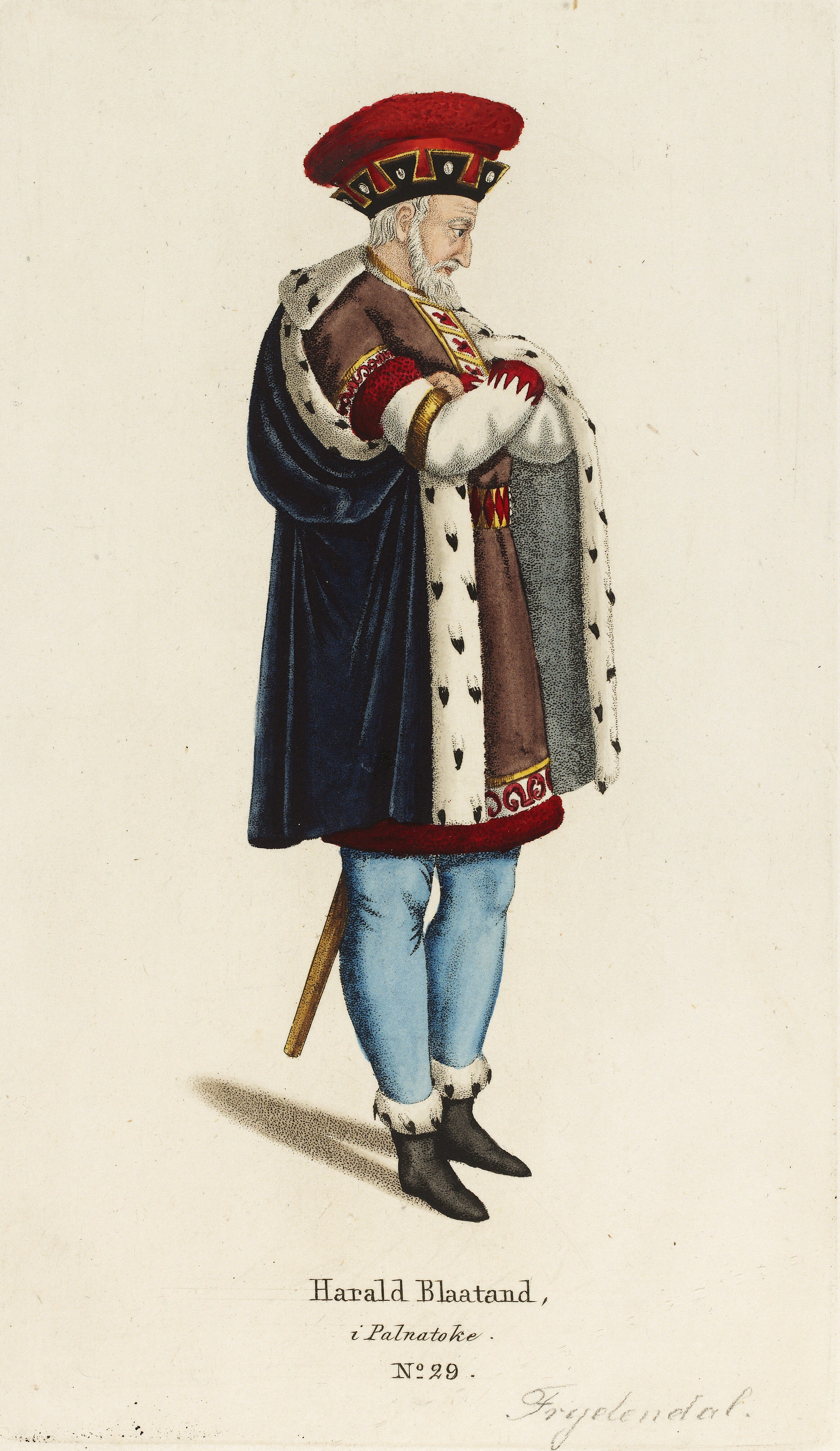
An anecdote from Norse mythology, a Viking incident, is then offered, which takes on the air of a parable. This is the story of Harald Bluetooth (Harald Sinihammas) - yes, the Bluetooth after whom the wireless communication technology is named - or rather his novel avatar, novel where he meets the intrepid Viking Red Orm (Orm Punainen). Orm returns from a tour of Spain adorned with a magnificent trinket. Bluetooth, then king of Denmark, invites him to stay at his court for the Christmas party. And party rule is lacking. He is challenged by a courtier who has his eye on his golden torcs. Knowing his health to be frail, he refuses to fight a duel in the open air so as not to catch cold. Never mind! King Harald, in his excitement, reviews the regulations in force: after all, a duel indoors does not upset the Christmas Peace that much. Orm cuts off his rival’s head, keeps his neck, and his necklace.
When extravagant banquets are met with laissez-faire, heads roll? That’s not the end. Our speaker, Dean of the Faculty of Law, does not refrain from stressing the Viking traits in the University’s Principal’s character. Before reminding us that the Vikings were pillagers, that the University of Turku was financed by gold miners in the American Far West, and concluding that a Viking would be very well suited to heading up the finances of the University of Helsinki. Cryptic enough. The tone is upbeat, and it’s a pleasure to read.
Let’s practice a little.
Viikingit olivat omalla tavallaan meri- ja kuljetusoikeuden asiantuntijoita ja edelläkävijöitä. - Ehkä pitää painottaa sanaa kuljetus enemmän kuin sanaa oikeus.
Vikings were in their own way experts and pioneers in maritime and transport law. - Perhaps one should emphasise the word transport more than the word law.
All of this reminds us of our last briefing on compound words. The second sentence demystifies one of them: kuljetus-oikeus for maritime law. Asian-tuntija is literally the knower (tuntija) of a thing (the genitive asian). Edellä-kävijä the in front- (the adverb edellä) walker (kävijä). We have fore-runner that is structurally close. But we find no obvious synthetic - composed - synonyms in English to maritime law, transport law or expert. German has Fachleute for expert, Fach-leute, the domain people. Here is a translation of the first sentence into German:
Die Wikinger waren auf ihre Weise Fachleute und Vorreiter im See- und Beförderungsrecht.
Vor-reiter is our forerunner or edelläkävijä. See-recht and Beförderung-s-recht are composed the same way as in Finnish, and German appears here to be a bit more synthetic than English. But what are you driving at with your syntheticism? Well, just saying Germanists, or practitioners of any language slightly more synthetic than English might have an edge. You glue, you tear off. The hack is productive, and all neologisms are fair game - your conversation partner will follow along, and you’ll have them cracking up without breaking any language rules. Meeresräuber in one word for sea thief or pirate, the German pendant for merirosvo. Ryöstelyasiantuntija has no dictionary entry of its own but is likely to be a very clear mapping to looting experts - in one German word Plünderung-s-experte. The Wikipedia article distinguishes between derivational synthetism (glueing words) and relational synthetism (glueing onto words units of meaning that do not exist in isolation, with good examples of the latter being suffixes of gender, number, grammatical case, or possession). Finnish does both, and very much so. We come up with panostellisinkohan, a one shot magic trick for I wonder if I should keep going all in (the reckless gambler).
panostaa (infinitive I: to go all in, to bet) → panosta- (its weak vowel stem) → panoste-le- (+frequentative-verb-forming suffix -le-, it’s the keep (going)) → panostellisi- (+conditional mode) → panostellisin (+1st person singular suffix: I should keep going all in) → panostellisinko (+interrogative particle -ko: Should I…?) → panostellisinkohan (+casual wondering -han: I wonder if I should…)
In a way, appending an -s to a noun to make it plural is already synthetic. So rather than a sharp dichotomy, there is a continuum whose poles are the synthetic and its contrary the analytic, along which languages are situated and evolve. Of course, the placement of the points on the line is not scientific, and there is much room here for debate.
What else is worth noticing? Tavallaan expresses possession: tapa means way, tavalla (the consonant gradation here changes the -p- to -v-) in this way, tavalla-an, in their own way. So why add omalla? Well, it’s own, which could be called redundant, except it actually plays a contrasting, disambiguating role.
Viikingit olivat omalla tavallaan …
Vikings were in their own way …
Not some others’. It is in its impersonal flavor that pitää is featured in
- Ehkä pitää painottaa …
- Perhaps one should emphasise …
In its first meaning pitää is to hold, to grasp, to keep. If it doing something grasps you or holds you in its claw, you have to to do it. We seem now ready for blinding the English and opening the second part of the exercise. Here is the broken English, without cheating
Viikingit olivat omalla tavallaan meri- ja kuljetusoikeuden asiantuntijoita ja edelläkävijöitä. - Ehkä pitää painottaa sanaa kuljetus enemmän kuin sanaa oikeus.
Vikings / were / in their own way / of sea and transport laws / experts and pioneers. - Perhaps / one should / emphasise / the word transport / more than / the word law.
We can’t say for sure what was on the orator’s mind. The era was one of financial scandal, that of perhaps a bit too ample and a bit too clandestine private financing during the 2007 election campaign. A precise language does not have as its virtue the preemptive resolution of all ambiguities. On the contrary, it sows them in abundance, and the language resonates with meaning.
And do you often think about Finnish in the woods? Well, sometimes. Most often the animation of the woods, the hushed footsteps of animals in the blueberry bushes, the melodies that play in the tops of the fir trees, the twirling of the spring snowflakes keep our whole spirit awake. The breathtaking spectacle of a vivid nature.
References
Nuotio, K. (2010). Viikinkiverta. In Löytönen, M., & Eskola, A. (Toim.). (2013). Suomalaisia puheita. Suomalaisen Kirjallisuuden Seura.
Lind, A. (2009). Itsenäisyys. In Löytönen, M., & Eskola, A. (Toim.). (2013). Suomalaisia puheita. Suomalaisen Kirjallisuuden Seura.
Korpela, J. K. (2026, February 18). Instructive [Section 8 of Handbook of Finnish, 2nd ed.]. https://jkorpela.fi/finnish/Instructive.html
Yle Uutiset. (2008, toukokuu 15). Vaalijohtaja: Vaalirahoituslain rikkominen melko yleistä. https://yle.fi/a/3-5836816