
#5 - Eastern border

It is not earlier than the 16th and 17th centuries, with the rise of absolutist, autocratic states, that the modern concept of territorial borders was established: a clear demarcation line under close control, serving both as a security and customs barrier. Previously, populations wandered unseen back and forth across frontiers, with no strong sense of territorial belonging. Frontier was then essentially a concept in domestic accounting. What was discriminated between were the respective taxpayer pools of each neighboring country.
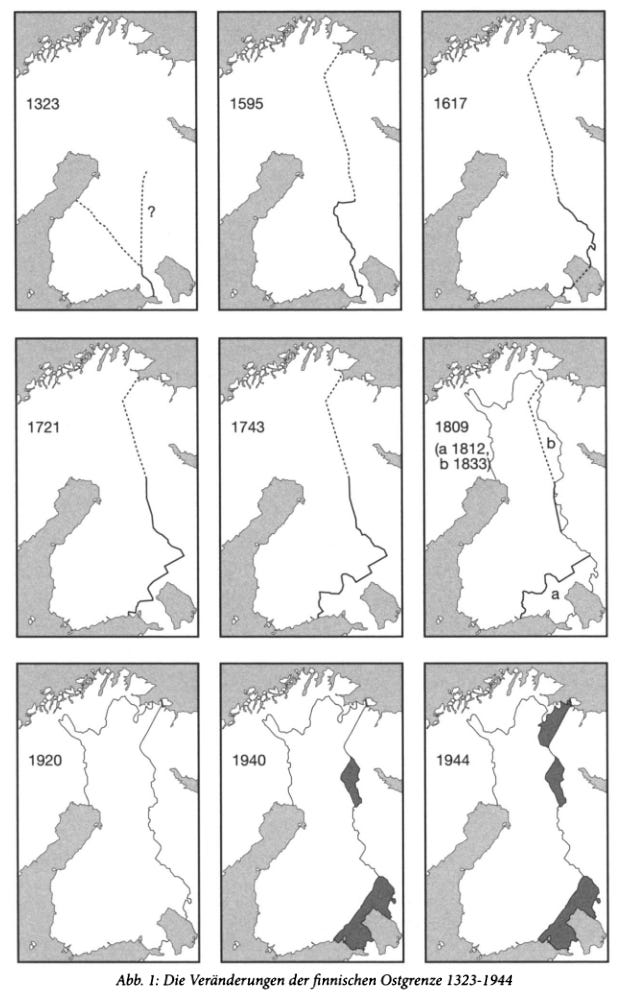
Sweden’s old eastern border with Russia, established by the Peace of Pähkinäsaari (Nöteborg) in 1323, is one of those porous and confusing medieval frontier areas. At the end of the 16th century, it is boiling over, under the combined effect of changes in the state, its expansionist policy, and life on the border.
Conflicts between settlers in the border areas become a matter of state concern, which negotiations can no longer contain. Farmland is disputed for several reasons. Once sparsely populated, borderlands are getting more crowded. On top of that, there is no more a physical border than there is agrarian sedentariness. Peasants are mobile settlers, clearing virgin land to make it arable (uudisraivaus, literally new clearing). So much so that enclaves of Russian taxpayers form in the west. Eventually, tax demarcation itself becomes confused. Under the rule of the Vasa kings, the concurrence of territorial rule and tax control becomes clear. A deliberate colonization policy through tax subjugation triggers migrations to the east. At the same time, Russian peasants are emigrating in the opposite direction - to escape heavy taxation. All of this occurs in the context evoked in the opening. In Sweden or Russia, the idea of a territorial state is crystallizing, yet the population has still not developed national sentiment or political loyalty towards its tax controller. Control technologies have yet to be invented, the confused border is prone to diverging interpretations and difficult to enforce, and skirmishes are taking place in the forests.
The so-called 25 Years' War (also Long Wrath, pitkä viha), which breaks out in 1570, is a border war. Fed by guerrilla warfare, its stakes are territorial and strategic. For a long time, control of Käkisalmi (Kexholm) and thereby Karelia's trade route, as well as influence in the Baltic Sea, have been disputed. (Katajala, 2010) The Peace of Täyssinä (Teusina) in 1595 is not enough. It does consolidate a new border extending to the Arctic Sea, stipulating the withdrawal of the Swedes from the Käkisalmi Strait and Ingria, but leaving them in control of the northern part of present-day Estonia and Narva. But Russia sinks into the Time of Troubles (Sekasorron aika) that ends the Rurik dynasty. A door of opportunity opens, which revives Swedish aspirations for territorial expansion.
The Peace of Stolbovo in 1617 calms things down. Sweden eventually receives Ingria and Käkisalmi County, and in return cedes Novgorod and Audova back to Russia. The new Russian stability discourages further attempts at expansion.
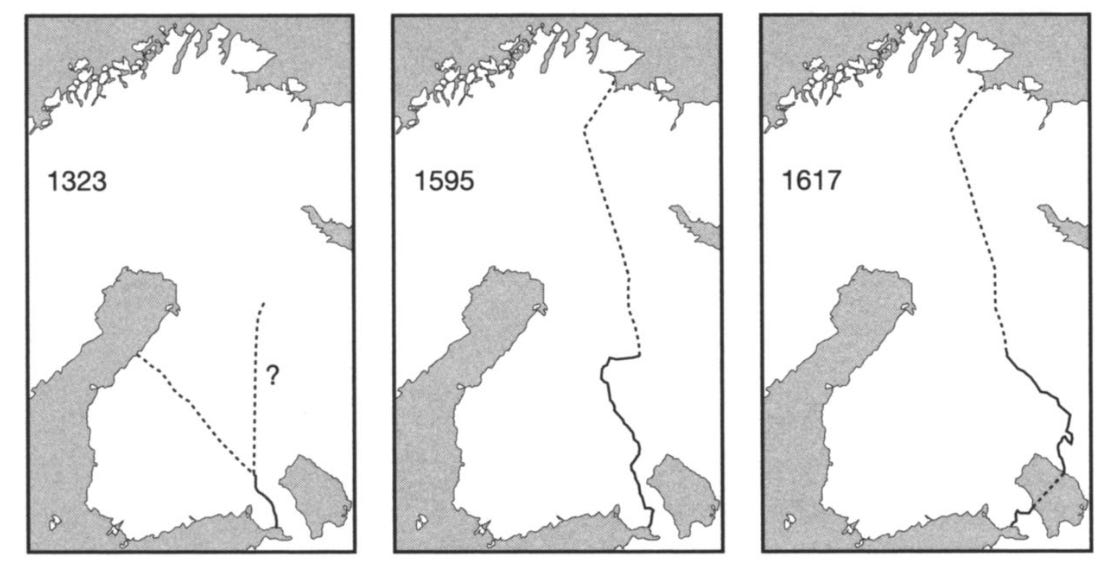
These are the pages of history one turns through when leafing through the pleasant Itärajan vartijat. 3, 1600-luku (Gullberg, 2005). Our interest is piqued, but we do not lose sight of what is at stake for us, we minor lords of modern times: the deciphering of Finnish.
Romanovien valtaantulon jälkeen Venäjää oli vakautettu ainakin niin paljon, ettei Ruotsi sen enempää kuin Puolakaan ainakaan sillä hetkellä ollut halukas ottamaan monimutkaisen ja kalliin sodan riskiä kaukana vieraalla maalla, missä oli vain vähän voitettavissa.
After the Romanovs came to power, Russia had been stabilized enough that neither Sweden nor Poland was willing, at least at that moment, to risk a complicated and costly war far away in foreign territory where there was little to be gained.
From wrestling with this seemingly recalcitrant sentence, let us see what we can gain.
The English sentence has a main clause, solid as a rock and which could function entirely independently:
... Russia had been stabilized ...
It admits an adverbial clause of time
After the Romanovs came to power, ...
and some kind of subordinate clause, trimming things a bit,
... enough that neither Sweden nor Poland was willing ... to risk a complicated and costly war far away in foreign territory ...
which embeds a relative clause characterizing the noun phrase foreign territory:
... where there was little to be gained.
What is the precise nature of the clause introduced by enough that? While differing significantly semantically, a syntactic equivalent seems
... Russia had been stabilized, so that neither ...
where so that has a resultative interpretation - leafing through a good grammar of English invites such terminology - as opposed to a purposive one. (Huddleston, 2002, p.1321-1322) From the notions and their illustrative sentences portrayed in said grammar, we feel indeed closest to
The dust clogged their throats, [so that the women were always making ice water].
to be distinguished from the purposive
He left early [so that he would miss the rush-hour traffic].
And our resultative so that, the grammar argues, is no canonical subordinating conjunction. First because the clause it introduces cannot occur in first position. We are invited to contrast the improper
*[So that the women were always making ice water,] the dust clogged their throats
with the fully acceptable
[So that he would miss the rush-hour traffic] he left early.
Second because coordinating two such resultative clauses introduced by so that is impossible:
*The dust clogged their throats, [so that they quickly felt parched] [and so that the women were always making ice water].
Maybe ungrammaticality is not that obvious. But it seems we can replace so by to such an extent without altering much, if anything, of the meaning and function. And here it feels more than clumsy:
*The dust clogged their throats, [to such an extent that they quickly felt parched] [and to such an extent that the women were always making ice water].
The second to such an extent (or so) is too much, improperly so. In contrast, coordination is no concern with usual subordinating conjunctions:
He left early because he suspected his daughter could be playing truant and because Mary needed him to pick up her parka from the dry cleaner.

So no subordinating conjonctions, hence no subordinate stricto sensu. Some clause of resultat. Let’s return to original text:
... Russia had been stabilized enough that neither Sweden nor Poland ..
Here enough is, as another chapter of said English grammar seems to indicate, a sufficiency determiner, used as a verb modifier as in
I don't like it enough to buy it at that price.
introducing a resultative content clause as in
There was enough hot water for us all to take a bath.
(Huddleston, 2002, p.396-397)
With eloquent precision, our grammar says sufficiency determiners « express imprecise quantification, being concerned with the lower bound required to satisfy some explicit or implicit need or purpose ».
And it is precisely in the expression of the lower bound that ainakin specializes in
… ainakin niin paljon, ettei …
literally
…. at least so much, that …
So
… enough, that …
How did we notice? Well, maybe the comma. The comma followed by ettei. Or niin paljon, ettei, literally so much, that. Maybe after a short while, we just know.
From there we are not long to find our main clause. All the more if we know, and we should from now on, that Venäjä, partitive Venäjää, is Russia.
… Venäjää oli vakautettu ainakin niin paljon, ettei …
… Russia had been stabilized enough that …
oli vakautettu clearly appears as our verb, it is a passive form, and a perfect past - a pluperfect in an English grammar of Finnish.
Let us learn to vary things a little. An interesting exercise spawning from the main one consists precisely in observing, even memorizing, the result of small variations around a theme - lexical, grammatical or conceptual. We change the variables by a small delta, and among outputs notice the patterns.
We were at vakautettu, passive past participle. Let us observe a few simple Finnish sentences, obtained from an automatic translator, from an English original containing a verb in the passive perfect past.
Talo on rakennettu 30-luvulla.
The house has been built in the 30s.
Kuningasta on nähty rajan tuolla puolen.
The king has been seen beyond the border.
Kello oli vedetty ylös kauan ennen kuin saavuimme.
The clock had been wound up long before we arrived.
Well, we notice some patterns here. Our three passive past participles rakennettu, nähty, vakautettu all end in -ttU or -tU with U realized as u or y depending on vowel harmony. A pretty good grammar tells us the passive past participle's construction can be thought of as: take the passive indicative past tense, subtract -iin, add u or y.
nähtiin (passive past indicative) → näht- → nÿhty (passive past participle)
A few words of caution.
Whereas the main exercise is based on Finnish material by a competent Finnish human being, thereby authentically Finnish, our variations are only as accurate as the automatic translator. Said variations are short and deprived of context. That means no context guides the translator towards a loyal translation - a translation actually translating what you had in mind, or actually illustrating the theme you wished to play around. Your raw English sentence or its equivalent Finnish might indeed be somehow ambiguous. And you might get a single translation with no warning that alternatives could exist, would a context be given.
Imprecisions, albeit small, might compound into wrong assumptions about grammar or usage, which then have to be corrected later. For example in the above, it is hard to tell whether the passive pluperfect is the adequate tense in the Finnish translations. The use of moods and tenses depends eminently on context, which is here missing. Put differently, it is not possible, from these variations, to infer anything concerning the use in Finnish of the passive pluperfect, nor which Finnish tense adequately translates an English perfect or pluperfect. On the other hand, they suffice to notice something of the forms. Ultimately, the exercise is safe as long as you keep sentences simple, don't trust the translation too far, and focus on the most important thing: the pattern you expected to reveal.
We can similarly amuse ourselves around the so-called resultative content clause, with a few variations:
Pöly tukki heidän kurkkuaan, niin että naiset olivat aina tekemässä jäävettä.
The dust clogged their throats, so that the women were always making ice water.
Hän lähti aikaisin, niin että hänen kollegansa joutui viimeistelemään työn.
He left early so that his colleague had to finish the work.
Hän seurasi ainakin niin paljon, että saattoi selittää sen myöhemmin kultakalalle.
She followed enough that she could explain it later to the golden fish.
Through repeated examples, we effortlessly retain, and for a long time, niin että or (ainakin) niin paljon, että.
We will pursue as in Paul Verlaine's paradoxical poems, (almost) sans paroles.
Romanovien valtaantulon jälkeen …
After the Romanovs came to power, …
Romanovien valtaantulon jälkeen …
After the Romanovs came to power, …
Romanovien valtaantulon jälkeen …
After the Romanovs came to power, …
valtaantulon is a noun, valtaan + tulo, literally coming to power, in the genitive certainly called for by jälkeen. We confirm by varying a little: tanssijaisten jälkeen for after the ball sateen, sateen jälkeen for after the rain.
It further breaks down into a subject,
…, ettei Ruotsi sen enempää kuin Puolakaan ainakaan sillä hetkellä ollut halukas ottamaan monimutkaisen ja kalliin sodan riskiä …
… that neither Sweden nor Poland was willing, at least at that moment, to risk a complicated and costly war …
where the neither … nor is embedded in the whole ofettei … sen enempää kuin; a verbal phrase
…, ettei Ruotsi sen enempää kuin Puolakaan ainakaan sillä hetkellä ollut halukas ottamaan monimutkaisen ja kalliin sodan riskiä …
… that neither Sweden nor Poland was willing, at least at that moment, to risk a complicated and costly war …
and its direct object
…, ettei Ruotsi sen enempää kuin Puolakaan ainakaan sillä hetkellä ollut halukas ottamaan monimutkaisen ja kalliin sodan riskiä …
… that neither Sweden nor Poland was willing, at least at that moment, to risk a complicated and costly war …
That’s in fact the head of the direct object, which goes much further
… ottamaan monimutkaisen ja kalliin sodan riskiä kaukana vieraalla maalla, missä oli vain vähän voitettavissa.
… to risk a complicated and costly war far away in foreign territory where there was little to be gained.
and entails a last, easy clause before to finish with:
…, missä oli vain vähän voitettavissa.
… where there was little to be gained.
…, missä oli vain vähän voitettavissa.
… where there was little to be gained.
…, missä oli vain vähän voitettavissa.
… where there was little to be gained.
…, missä oli vain vähän voitettavissa.
… where there was little to be gained.
All the hungry ones will go into even more detail, ad libitum.
But then, where was Finland in the 16th century? Nowhere.
So where were the Finns and their Finnish language? Under Swedish rule.
Any consequences? For sure. Swedish is an official language of Finland. Finnish has Swedish loanwords, of which we have already encountered at least one specimen: malli, borrowed from the Swedish mall, itself a derivative of the Latin modulus.
References
Gullberg, T., Huhtamies, M., & Klinge, M. (2005). Itärajan vartijat. 3, 1600-luku. Schildt.
Katajala, K. (2010). Zwischen West und Ost. 800 Jahre an der Ostgrenze Finnlands. Kirchliche Zeitgeschichte, 23(1), 81–110.
Korpela, J. (2002). Finland's eastern border after the treaty of Nöteborg: An ecclesiastical, political or cultural border? Journal of Baltic Studies, 33(4), 384–394. https://doi.org/10.1080/01629770200000181
Huddleston, R., & Pullum, G. K. (2002). The Cambridge Grammar of the English Language. Cambridge University Press.
Korpela, J. K. (2026, February 18). Participles [Section 15 of Handbook of Finnish, 2nd ed.]. https://jkorpela.fi/finnish/Participles.html